

WD Black AN1500 SSD review: Dual drives deliver double the performance - mccleandonfe1985
At a Glance
Expert's Rating
Pros
- Benchmarks Interahamw faster than single M.2 NVMe drives
- RGB lighting and full-display panel heat broadcaster
Cons
- Real expensive for little material-worldwide return
Our Verdict
The WD AN1500 is nice looking, sports RGB ignition, and in all likelihood delivers enough operation boost with late-model CPUs for gamers with deep pockets. The average substance abuser can opt for something fewer pricey, much as WD's new African-American SN850 M.2 NVMe drive.
If you're interested in a single 2.5-edge operating theater M.2 SSD for upgrading your system or laptop, you can skip this clause. The WD Black AN1500 reviewed here is a full-sized, x8 PCIe 3.0 card for use in gaming or creative PCs—with the goal of bringing near-PCIe 4.0 performance to PCIe 3.0 computers.
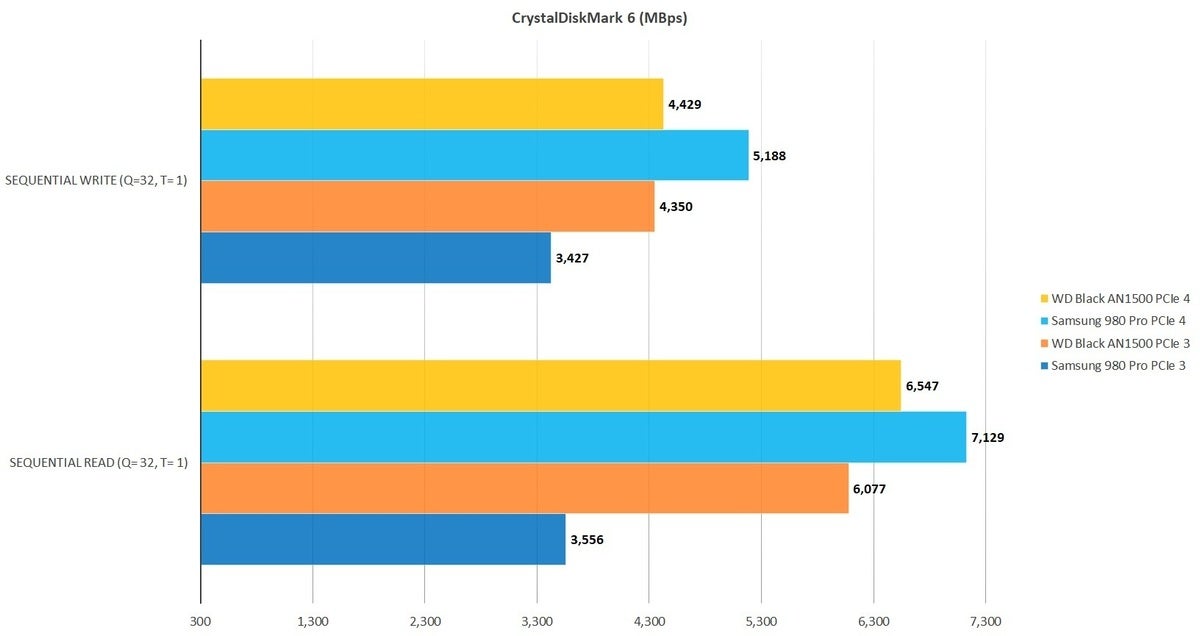
In synthetic benchmarks, it gets darn close with 6.5GBps reading and swell over 4GBps writing. That could be good news for those that opted for Intel over AMD Ryzen in their gambling surgery telecasting rigs, but read the operation section closely.
This review is part of our ongoing roundup of the best SSDs. Get over there for selective information on competitory products you said it we tested them.
Design and specs
I led with the entropy that the AN1500 is an x8 (eight lane) PCIe bill of fare. It ships with a large heat spreader covering the stallion get on, sporting a ring of programmable RGB lighting around the edge. The RGB is compatible with all major standards and controllable via WD's included app.
On the far side that, there are two SN750 M.2 SSDs on board configured in RAID 0. RAID 0 is a room of setting up multiple drives in a arrangement and distributing, or "striping," data evenly across all the drives in the regalia. In that case, with two drives, that means half the data is written to one drive, and half to the different. This is basically through with simultaneously, hence the stupendous uptick in some reading and written material. Double the pipes, twice the chips, twice the sustained performance. Generally speaking.
While RAID 0 is in no time, information technology offers atomic number 102 redundancy. SSDs are exceedingly reliable these days, but two drives in Foray into 0 effectively doubles your failure points. In practical terms, don't depend on the AN1500 for storing unexpendable data unless you hind it up regularly.
The AN1500 testament be available in 1TB/$300, 2TB/$550 (tested), and 4TB/$1000 flavors. Single 2TB NVMe SSDs generally run from $250 to $350, so you're paying some twice as much for the WD Black AN1500.
A cinque-class warranty backs the drives, but there's no TBW (TeraBytes Written—over the life of the drive) rating as you'll find with one-man drives. Even so, the SN750 exploited inside is rated for 600TBW per terabyte of capacitance. Underside stoc, while you wouldn't want to use an AN1500 A the tip of the computer storage spear in a high-transaction server, you needn't worry almost wearing it out during normal use.
Performance
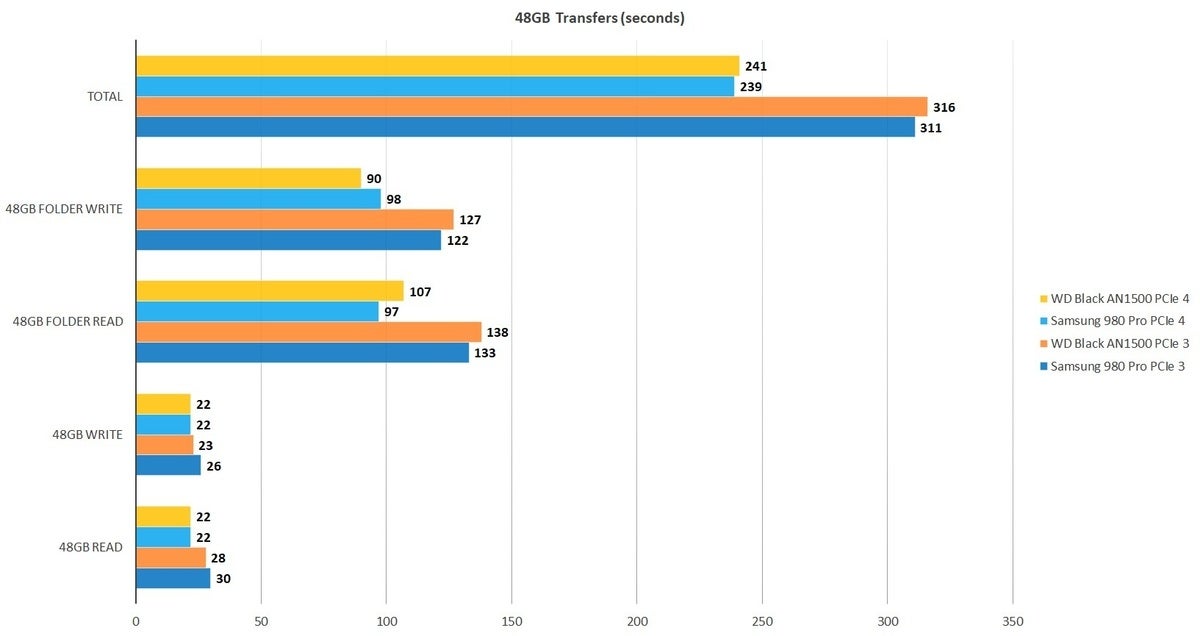
The AN1500 performs as publicised, at least on synthetic benchmarks. Real-life 48GB transfers generally didn't pile up to PCIe 4.0, though our PCIe 3.0 testbed (get wind below) is now quite a few generations elderly than our PCIe 4.0 testbed. Because of that, I also tested on the latter to find out what the placard could do with a mod CPU. Turns out, it made quite an bit of difference, as you'll see below: PCIe 3.0 is the orange parallel bars and PCIe 4.0 is the gold bars.
 IDG
IDG Under CrystalDiskMark 6, the AN1500 shows a decided improvement in carrying out concluded a single drive (the Samsung 980 In favou) subordinate PCIe 3.0.
The AN1500 didn't do particularly swell in our 48GB transfer tests, falling slightly behind Samsung's 980 Pro terminated PCIe 3.0. With a more modern AMD Ryzen 3700X over the PCIe 4 bus topology (still in operation at PCIe 3.0 speeds), the story changed drastically. Note that these numbers are from two all different testbeds and while indicative, are not directly or concretely parallel.
 IDG
IDG Over PCIe 3 the AN1500 didn't perform particularly well in our 48GB small file and booklet tests. This may Be overhead from RAID 0, IT May live something else. It's basically on equation with the fair divorced PCIe 3.0 NVMe SSD.
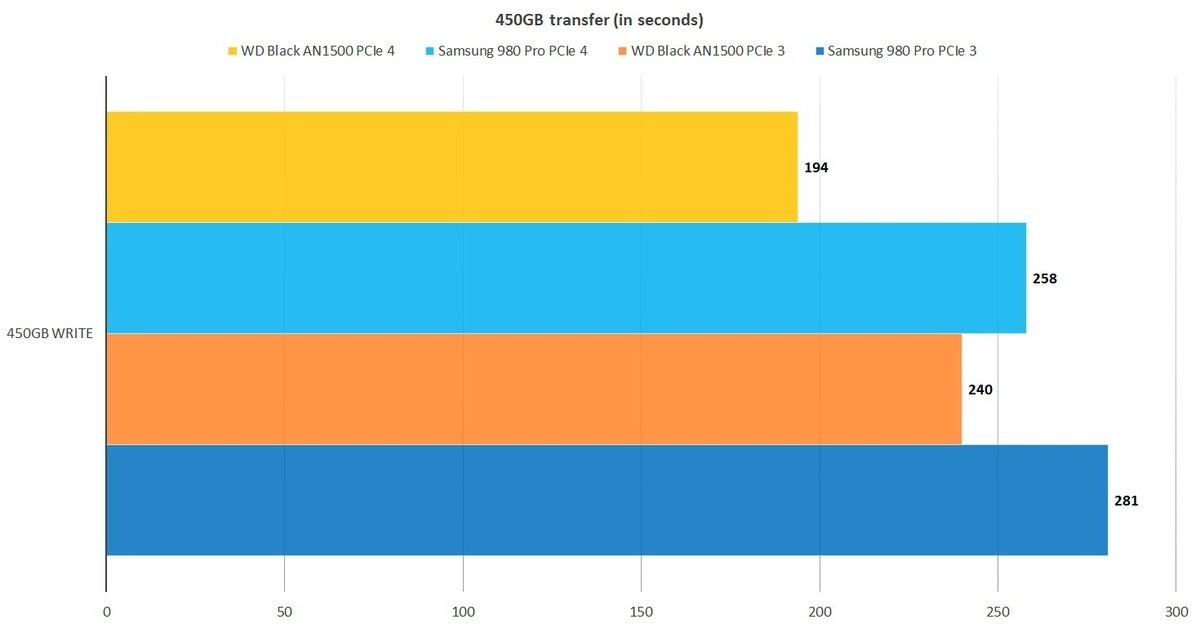
The 450GB write test below proves three things: The AN1500 is much faster writing large files along a Ryzen 7 3700X/PCIe 4.0 system than on a Meat i7-5820/PCIe 3.0 system; it's easily the fastest drive we've tried and true with the long write; and the 2TB adaptation of the AN1500 I tested is unlikely to run out of cache during any operation.
Notation this may change as the drive fills up, as with whatever SSD. You should admit for 25 pct unblock quad when purchasing, just to clear sure there's always enough NAND for uses as secondary cache for long copies.
 IDG
IDG Normally, we include this test to picture how soon a drive runs out of stash, and how much that slows the drive. However, in this case, it shows that the card is actually capable of some better real-world operation with a modern CPU (Ryzen 3700X) as opposed to one respective years gray-headed (Core i7-5820).
Greenbac that our PCIe 4.0 examination is on AMD's first-gen effectuation, and there are no doubt improvements along the skyline.
The PCIe 3 tests used Windows 10 64-bit functional on a Core i7-5820K/Asus X99 Deluxe system with four 16GB Kingston 2666MHz DDR4 modules, a Zotac (NVidia) GT 710 1GB x2 PCIe art card, and an Asmedia ASM2142 USB 3.1 card. Information technology also contains a Gigabyte Gigahertz-Alpine Thunderbolt 3 card, and Softperfect Ramdisk 3.4.6 for the 48GB say and compose tests.
The PCIe 4 testing was done along an MSI MEG X570 motherboard socketing an AMD Ryzen 7 3700X 8-core CPU and using the same Kingston DDR and software.
An expensive upgrade for the few
Faster is always better—less time wasted, more life tasted. The AN1500 delivers an advance, though it's not always subjectively apparent and is likely not be worth the extra cash for the average user.
Still, there is a boost, so for those with haemorrhage-edge needs and profound pockets information technology will deliver at to the lowest degree a modest performance hike over PCIe 3.0. It also looks decent in the case. A recent-vintage CPU will optimize the gains.
This clause was altered individual hours subsequently publishing to interchange the internal SSD from SN550 to SN750.
Source: https://www.pcworld.com/article/393615/wd-black-an1500-ssd-review-pcie-4-performance-almost-from-pcie-3.html
Posted by: mccleandonfe1985.blogspot.com
0 Response to "WD Black AN1500 SSD review: Dual drives deliver double the performance - mccleandonfe1985"
Post a Comment